Showing posts with label Change and Conflict. Show all posts

Saturday, February 8, 2014

Change: Organizational & Individual Perspectives

Types of Organizational Change

1.      Anticipatory changes: Planned changes based on expected situations
2.      Reactive changes: Changes made in response to unexpected situations
3.      Incremental changes: Subsystem adjustments required to keep the organization on course
4.      Strategic changes: Altering the overall shape or direction of the organization
Four Types of Organizational Change

Organizational & Individual Perspectives

1.      Tuning: The most common, least intense, and least risky type of change. Also known as preventive maintenance and kaizen (continuous improvement). Key is to actively anticipate and avoid problems rather than waiting for something to go wrong
2.      Adaptation: Incremental changes that are in reaction to external problems, events, or pressures. 3.      Reorientation: Change that is anticipatory and strategic in scope and causes the organization to be significantly redirected. Also called “frame bending” (Nadler and Tushman). 
4.      Re-Creation: Intense, risky, and decisive change that reinvents the organization. Also called “frame breaking” (Nadler and Tushman)


Individual Reactions to Change happens on an individual level, even in the workplace. How People Respond to Changes They Like
Three-stage process
1.      Unrealistic optimism
2.      Reality shock
3.      Constructive direction
How People Tend to Respond to Changes They Like

On-the-Job changes generally are more feared than welcomed. How People Respond to Changes They Fear and Dislike. 

Stages
1.      Getting off on the wrong track
2.      Laughing it off
3.      Growing self-doubt
4.      Buying in
5.      Constructive direction
How People Respond to Changes They Fear and Dislike

 How to Help Individuals Deal with Change: A Contingency Approach


Why Do Employees Resist Change?

  • Surprise: Unannounced significant changes threaten employees’ sense of balance in the workplace.
  • Inertia: Employees have a desire to maintain a safe, secure, and predictable status quo.
  • Misunderstanding/Ignorance/Lack of Skills: Without introductory or remedial training, change may be perceived negatively.
  • Emotional Side Effects: Forced acceptance of change can create a sense of powerlessness, anger, and passive resistance to change.
  • Lack of Trust: Promises of improvement mean nothing if employees do not trust management.
  • Fear of Failure: Employees are intimidated by change and doubt their abilities to meet new challenges.
  • Personality Conflicts: Managers who are disliked by their employees are poor conduits for change.
  • Poor Timing: Other events can conspire to create resentment about a particular change.
  • Lack of Tact: Not showing sensitivity to feelings can create resistance to change.
  • Threat to Job Status/Security: Employees worry that change threatens their job or security.
  • Breakup of Work Group: Changes can tear apart established on-the-job social relationships.
  • Passive-Aggressive Organizational Culture: The more things change, the more they stay the same.
  • Competing Commitments: Change can disrupt employees in their pursuit of other goals.

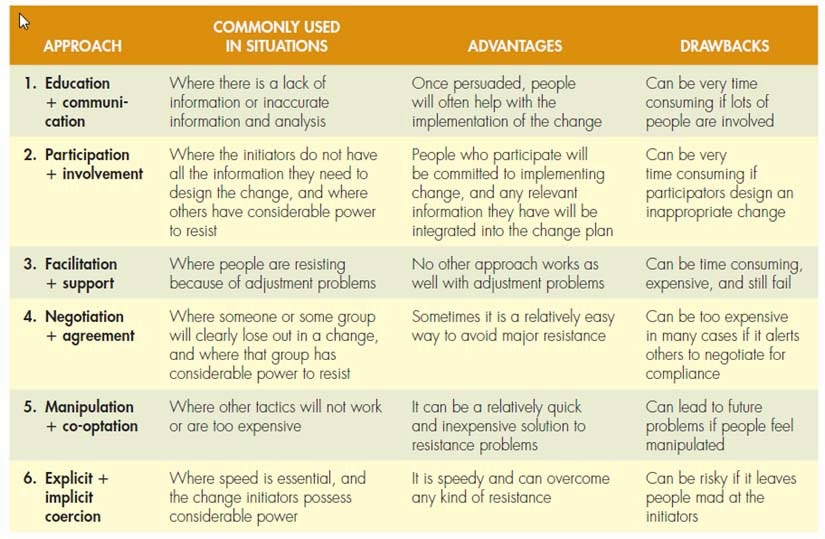
Strategies for Overcoming Resistance to Change

Strategies for Overcoming Resistance to Change
1.      Education and communication
2.      Participation and involvement
3.      Facilitation and support
4.      Negotiation and agreement
5.      Manipulation and co-optation
6.      Explicit and implicit coercion
Dealing with Resistance to Change

Making Change Happen

Two Approaches to Organizational Change
1.      Organization Development (OD): A planned change programs intended to help people and organizations function more effectively Formal top-down approach.
2.      Grassroots change: Unofficial and informal bottom-up approach

Objectives of OD

Deepen sense of organizational purpose. Strengthen interpersonal trust. Encourage problem solving rather than avoidance. Develop a satisfying work experience. Supplement formal authority with knowledge and skill-based authority. Increase personal responsibility for planning and implementing. Encourage willingness to change.

The OD Process

Unfreezing: Neutralizing resistance by preparing people for change
Change: Introduction of the intervention
Refreezing: Systematically following a change program for lasting results
A General Model of OD

Unofficial and Informal Grassroots Change

Tempered Radicals: People who quietly try to change the dominant organizational culture in line with their convictions
Guidelines for tempered radicals:
1.      Think small for big results.
2.      Be authentic.
3.      Translate.
4.      Don’t go it alone.
The 5P Checklist for All Change Agents

Managing Conflict

Conflict: One person’s incompatible behaviors that make another person’s actions less effective

Dealing with the Two Faces of Conflict

1.      Competitive conflict: Parties pursuing directly opposite (win-lose) goals
2.      Cooperative conflict: A mutually reinforcing experience (win-win) that serves the best interests of both parties
Competitive Versus Cooperative Conflict

Conflict Trigger: Any factor that increases the chances of conflict
Conflict Triggers
Ambiguous or overlapping jurisdictions
Competition for scarce resources
Communication breakdowns
Time pressure
Unreasonable standards, rules, policies, or procedures
Personality clashes
Status differentials
Unrealized expectations
Resolving Conflict
  Doing nothing is usually not a viable option.
  Conflict Resolution Techniques
1.      Problem solving
2.      Superordinate goals
3.      Compromise
4.      Forcing
5.      Smoothing

Negotiating and AVN

Negotiation: A decision-making process among interdependent parties with different preferences
Common Types of Negotiation
1.      Two-party negotiation (e.g., buyer and seller)
2.      Third party negotiation (e.g., agents and arbitrators)

Elements of Effective Negotiation

Adopting a win-win attitude: Understanding that a mutually beneficial agreement addresses both parties’ interests
Knowing your BATNA (best alternative to a negotiated agreement): Your “bottom line” for accepting or rejecting offers
Identifying the bargaining zone: Negotiation is useless if both parties involved have no common ground on which to maneuver during bargaining.
 The Bargaining Zone for Negotiators

Added Value Negotiating (AVN)

A practical five-step win-win process involving the development of multiple deals. Clarify subjective and objective interests; seek common ground.. Identify options and their marketplace values. Design alternative deal packages that foster a creative agreement. Select a mutually acceptable deal that is feasible for both parties. Perfect the deal by strengthening relationships for future negotiations.